
Here is the counterintuitive truth about most knee pain: it usually does not start in the knee. The knee is the hinge caught between the hip and the ankle, and when the muscles that control those joints are weak or poorly coordinated, the load lands in the middle. That is why strengthening, not resting, is the standard modern approach for most persistent knee pain, and why a low-impact, alignment-obsessed method like Pilates fits the problem so well.
Pilates can help people with knee pain by strengthening the muscles that protect the joint, the quadriceps, glutes and stabilizers, with low impact. A large share of knee pain comes from weakness or poor alignment rather than the joint itself, and addressing those, under guidance, usually brings relief.
01Why the knee hurts
Many knee complaints are born upstream or downstream of the joint: a hip that does not control rotation, an ankle that does not stabilize, and a knee that pays for both. When the surrounding chain is weak or misaligned, every step and every stair sends load where it should not go. Strengthening and realigning the leg chain removes that pressure, and that is precisely the kind of work Pilates does well.
02How Pilates helps
It strengthens the quadriceps
The quads are the key stabilizer and shock absorber of the knee. Spring resistance lets them be loaded progressively, without the impact of jumping or running.
It activates the glutes
Strong glutes keep the thigh aligned and stop the knee from collapsing inward, one of the most common mechanical causes of pain.
It improves alignment
Pilates trains hip, knee and ankle control together as one chain, so better mechanics carry over to walking, stairs and sport.
It keeps impact low
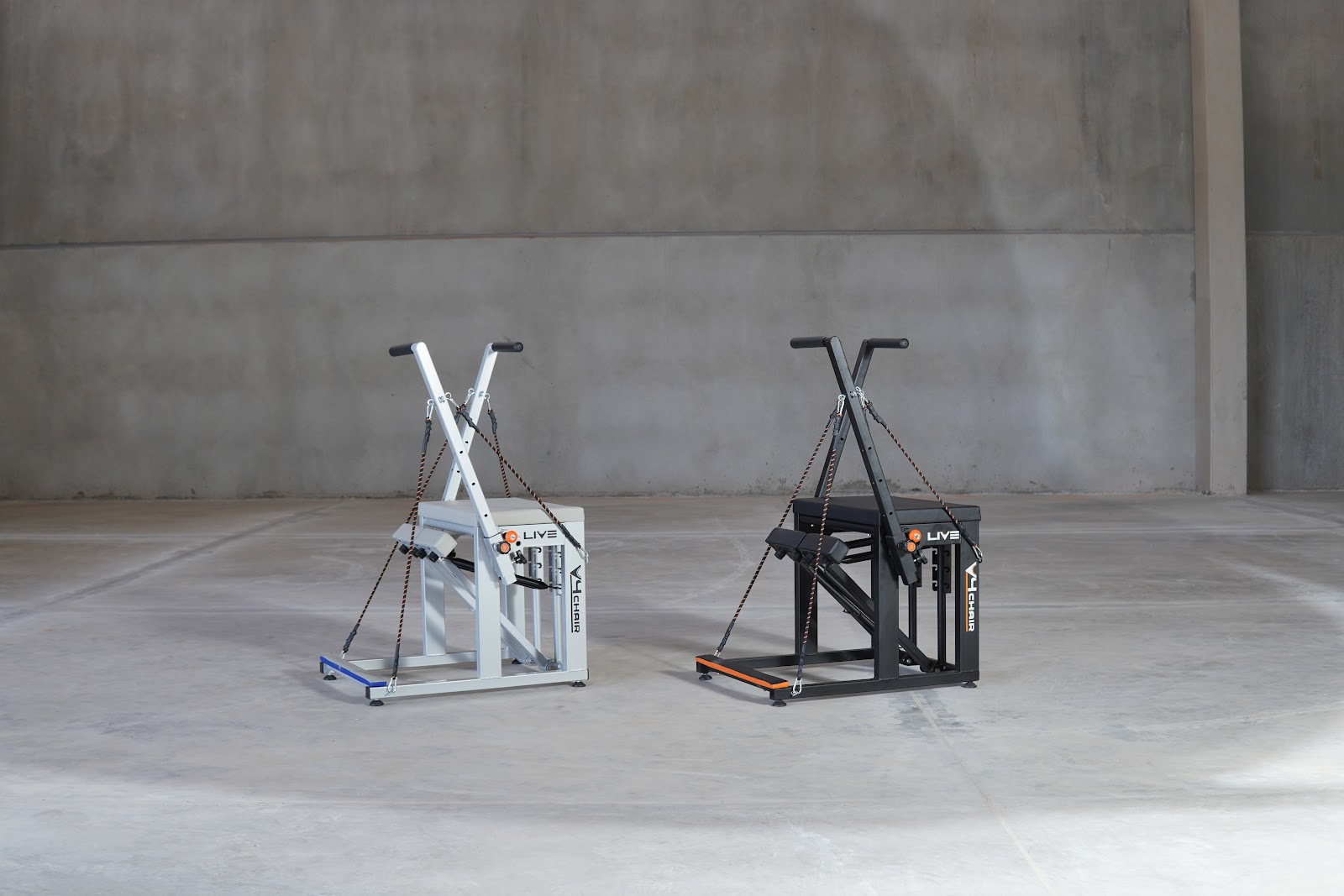
Sliding carriages and spring towers load the legs smoothly, which sensitive joints tolerate far better than impact work. Apparatus like the chair and reformer specialize in exactly this kind of leg training; our machine guide breaks down what each contributes.
03What to prioritize and what to watch
Prioritize
- Quadriceps and glute strengthening.
- Alignment control through the whole leg.
- Range of motion within comfort.
- Measured spring progression.
Be careful with
- Deep squatting through pain.
- High loads without control.
- Movements that lock or catch painfully.
- Forcing range beyond your limit.
04When to see a professional first
Pain with swelling, locking, painful clicking or a feeling of instability deserves a medical evaluation before exercise. Pilates then serves as part of rehabilitation and prevention, not as a replacement for diagnosing the cause. For studios building a joint-health offering, both individual apparatus sessions and group formats can serve this audience well.
This article is for general information only and is not medical advice. Knee pain accompanied by swelling, locking, instability or persistent symptoms should be evaluated by a health professional before you begin an exercise program.