
The 34 original Pilates exercises were created by Joseph Pilates and published in his 1945 book Return to Life Through Contrology. They are mat exercises, performed in one continuous sequence that trains core strength, control, flexibility and breath. That order remains, to this day, the spine of the classical method.
The 34 original Pilates exercises are the mat (floor) sequence Joseph Pilates published in Return to Life Through Contrology (1945), beginning with The Hundred and ending with the Push Up. They are performed in a set order, each exercise preparing the next, and they remain the foundation on which all apparatus work is built.
01Who created them, and why
Joseph Pilates called his method Contrology: the conscious control of movement by the mind. The 34 exercises were conceived as one fluid sequence in which every movement prepares the body for the next, working from the center, the region he called the powerhouse, out to the extremities. The sequence was never a random collection of exercises; it is a designed progression.
02The complete list, in classical order
The names are traditionally kept in English, exactly as Joseph Pilates published them. Difficulty builds from the most accessible entry point, The Hundred, to demanding closers like Control Balance and the Push Up.
| # | Exercise | # | Exercise |
|---|---|---|---|
| 01 | The Hundred | 18 | Shoulder Bridge |
| 02 | Roll Up | 19 | Spine Twist |
| 03 | Roll Over | 20 | Jack Knife |
| 04 | Leg Circles | 21 | Side Kick |
| 05 | Rolling Like a Ball | 22 | Teaser |
| 06 | Single Leg Stretch | 23 | Hip Twist |
| 07 | Double Leg Stretch | 24 | Swimming |
| 08 | Spine Stretch Forward | 25 | Leg Pull Front |
| 09 | Open Leg Rocker | 26 | Leg Pull Back |
| 10 | Corkscrew | 27 | Side Kick Kneeling |
| 11 | The Saw | 28 | Side Bend |
| 12 | Swan Dive | 29 | Boomerang |
| 13 | Single Leg Kick | 30 | Seal |
| 14 | Double Leg Kick | 31 | Crab |
| 15 | Neck Pull | 32 | Rocking |
| 16 | Scissors | 33 | Control Balance |
| 17 | Bicycle | 34 | Push Up |
03Why the order matters
An integrated sequence
Each exercise warms up and prepares the one that follows. Skipping steps removes the internal logic that makes the sequence more than the sum of its parts.
Natural progression
The order climbs from basic core stability toward advanced whole-body control, so the practitioner is never asked to control what has not yet been prepared.
Flow
Continuous transitions keep rhythm, breath and concentration unbroken, which is where much of the training effect lives.
Foundation of the repertoire
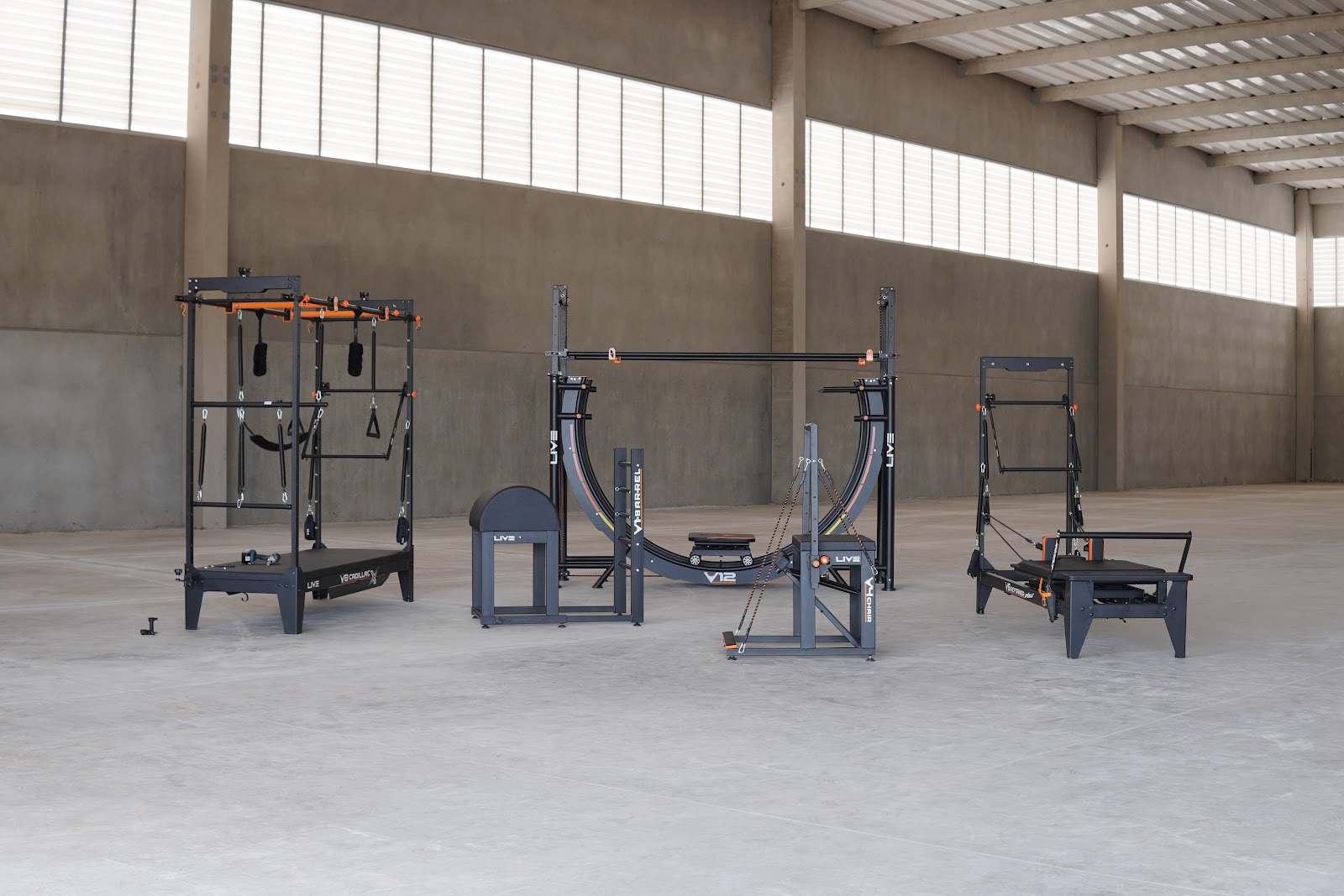
The apparatus exercises, on the Reformer, the Cadillac and the rest of the studio lineup, extend these same principles rather than replacing them.
04How mat and apparatus connect
The mat repertoire is the foundation. On the apparatus, spring resistance can either assist a movement, making it accessible, or resist it, making it harder, which is what allows a studio to individualize the same movement patterns for beginners, athletes and rehabilitation clients. That is why most professional studios program mat and apparatus work into the same lesson plan. If you want to understand the machines that carry the repertoire beyond the floor, start with our guide to the best Pilates machines for a professional studio, or compare the two settings directly in Reformer vs. mat Pilates.
Source: Joseph H. Pilates, Return to Life Through Contrology (1945), the book that documents the original sequence.
Several of the 34 exercises are advanced. Build up under the guidance of a qualified instructor, especially if you have a spine condition or are returning from injury.